

MFS in Forensic Chemistry
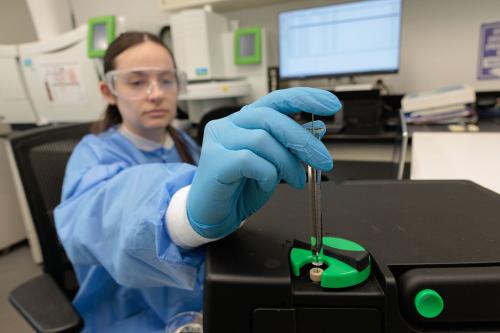
The Master of Forensic Science in Forensic Chemistry expands on the general MFS program curriculum with advanced work in medicinal chemistry, instrumental analysis and trace evidence analysis. The degree is FEPAC-accredited.
Students gain the skills to understand and interpret material composition, uncover drug compositions and identify chemical components at the molecular level.
Focus Areas
Students gain the skills to evaluate and interpret chemical and material crime scene evidence. These skills are valued by law enforcement agencies, crime labs, coroner's offices, hospitals and courtrooms. Our alumni also work in the private sector evaluating DNA, researching drugs and developing new products.
Program Objectives
Students graduate with:
- Deep knowledge of medicinal, forensic and forensic drug analysis
- Mastery of trace evidence analysis: hair and fibers, glass and soil, paper, paint, ignitable liquids and explosive residues
- Working knowledge of ethics, criminal law and statistics
- Familiarity with modern instrumental methods used in forensic laboratories, including mass spectrometry, optical spectroscopy, microscopy, chromatographic and electrophoretic separations
- Communication skills necessary to present findings with clarity
Application Requirements
The Department of Forensic Sciences requires applicants to hold a bachelor's degree in chemistry from an accredited university. Preference is given to students who have extensive laboratory experience with instrumentation analysis through undergraduate research, internships or Federal Work-Study programs.
Complete Application Requirements
Course Requirements
This Bulletin covers the degree requirements for students matriculating in the current academic year. Students who matriculated before the current year can find their requirements in the relevant archived Bulletin.
The following requirements must be fulfilled:
The general requirements stated under Columbian College of Arts and Sciences, Graduate Programs.
37 credits, including 31 credits in required courses and 6 credits in elective courses. In addition, successful completion of a master's comprehensive examination and an independent research project are required.
| Code | Title | Credits |
|---|---|---|
| Required | ||
| FORS 6001 | Research and Professional Responsibility | |
| FORS 6004 | Principles of Forensic Investigation | |
| FORS 6005 | Principles of Forensic Analysis | |
| FORS 6206 | Trace Evidence Analysis | |
| FORS 6210 | Advanced Instrumental Analysis | |
| FORS 6224 | Criminal Law for Forensic Scientists | |
| FORS 6225 | Statistics for Forensic Scientists | |
| FORS 6238 | Forensic Chemistry I | |
| FORS 6239 | Forensic Chemistry II | |
| FORS 6240 | Forensic Drug Analysis | |
| FORS 6292 | Graduate Seminar | |
| Electives | ||
| 6 credits in elective courses selected in consultation with the departmental advisor. | ||
| Additional requirements | ||
| Successful completion of the master’s comprehensive examination. | ||
| Successful completion of an independent research project. | ||