

MFS in Forensic Molecular Biology
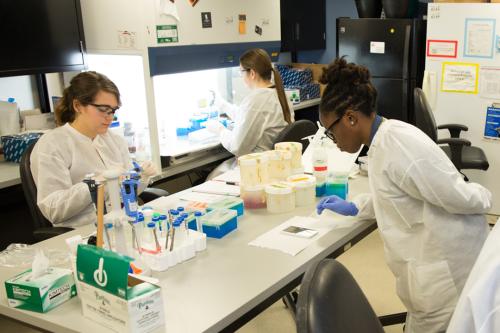
The Master of Forensic Sciences in Forensic Molecular Biology (FMB) program prepares students for careers in crime laboratories as DNA analysts and technical leaders. Through this FEPAC-accredited curriculum, students develop the analytical and research skills necessary to interpret, evaluate and understand biological evidence within a forensic context.
Working with the same technology currently used in operational crime laboratories, students gain hands-on experience with chemical, physical, immunological and microscopic techniques, as well as advanced molecular biology methods such as DNA extraction, amplification, capillary electrophoresis, probabilistic genotyping and next-generation sequencing.
Beyond the structured coursework, students participate in independent and collaborative research that applies emerging technologies to real-world forensic challenges. These projects make use of cutting-edge tools such as massively parallel sequencing and advanced bioinformatics pipelines, exposing students to innovations that are transforming the field. Through this research experience, students gain the expertise and adaptability needed to become the next generation of forensic molecular biologists equipped to lead in a rapidly evolving scientific landscape.
Coursework integrates both theoretical and practical learning, with opportunities to identify body fluids at reconstructed crime scenes and participate in mock court proceedings. These immersive experiences equip students with the skills to properly collect, preserve and analyze evidence, and to effectively serve as expert witnesses in courtroom settings.
"We were able to go through the analysis as if we were real analysts on this case. Once we analyzed the data, we were able to put it through a [simulated DNA] database."
Sathya Prakash Harihar
MS '20
Program Objectives
Graduates develop the knowledge and skills needed to work in a crime forensic laboratory. Specifically, graduates will:
- Obtain hands-on physical evidence analysis experience, such as the design, development and validation of forensic DNA analysis
- Improve critical thinking skills to evaluate forensic evidence and scientific literature
- Develop presentation and writing skills for research, report writing and courtroom testimony
- Understand the breadth of forensic science disciplines and their application to criminal justice
- Comprehend the legal and ethical principles of forensic science
Focus Areas
Students choose from required and elective courses in five subject areas:
- Chemical, Physical, Immunological and Microscopic Methods
Students combine disciplines to examine and identify body fluid stains at a crime scene and in the laboratory.
- Theoretical and Practical Aspects of Advanced Methods in Forensic Molecular Biology
Students learn methods of DNA extraction, quantitation, and amplification (of short tandem repeat markers and mitochondrial DNA), fragment analysis, DNA sequencing, data interpretation, mixture deconvolution and skills to evaluate population genetics.
- Forensic Physical Sciences
Students combine classic investigative examination techniques (such as fingerprinting, firearm and toolmark examination and document examination) with leading approaches used to examine trace evidence (such as glass, soil, paint, hairs and fibers and forensic drug analysis). Students learn the principles of forensic pathology, crime scene investigation and forensic science laboratory management.
- Principles of Criminal Law and Procedure
Students learn to prepare and present evidence, how to qualify and prepare expert witnesses and how to testify as an expert witness or present findings in a legal setting.
- Laboratory Classes
Students participate in mock cases to establish professional protocols necessary to receive evidence, maintain the chain of custody, analyze the evidence, calculate the statistical significance of a match, issue a report and return the evidence intact. Mock cases include methodology to identify and determine the nature of body fluids, extract, quantify and type the DNA, interpret the data and present it accurately.
Application Requirements
In addition to the Columbian College’s graduate admissions requirements, applicants must meet two requirements to apply for the MFS in Forensic Molecular Biology program:
- Applicant must have a bachelor’s degree in the biological sciences from an accredited college or university.
- Applicant must show 9 credits of completed coursework in certain areas before beginning the program. These courses must be taken as part of the undergraduate curriculum or before registering for graduate classes:
- Biochemistry
- Genetics
- Molecular biology
- Upon completion of the program, in order to meet FBI standards for a forensic DNA technical leader, students will be required to take two courses: Forensic Statistics and Population Genetics.
Complete Application Requirements
Course Requirements
This Bulletin covers the degree requirements for students matriculating in the current academic year. Students who matriculated before the current year can find their requirements in the relevant archived Bulletin.
The following requirements must be fulfilled:
The general requirements stated under Columbian College of Arts and Sciences, Graduate Programs.
37 credits, including 31 credits in required courses and 6 credits in elective courses. In addition, successful completion of a master's comprehensive examination and an independent study project are required.
| Code | Title | Credits |
|---|---|---|
| Required | ||
| FORS 6001 | Research and Professional Responsibility | |
| FORS 6004 | Principles of Forensic Investigation | |
| FORS 6005 | Principles of Forensic Analysis | |
| FORS 6201 | Forensic Biology | |
| FORS 6224 | Criminal Law for Forensic Scientists | |
| FORS 6225 | Statistics for Forensic Scientists | |
| FORS 6241 | Forensic Molecular Biology I | |
| FORS 6242 | Forensic Molecular Biology II | |
| FORS 6243 | Forensic Molecular Biology III | |
| FORS 6247 | Population Genetics | |
| FORS 6292 | Graduate Seminar | |
| Electives | ||
| 6 credits in elective courses selected in consultation with the advisor | ||
| Additional requirements | ||
| Successful completion of a master’s comprehensive examination. | ||
| Successful completion of an independent research project. | ||